Most manufacturing plant managers know manual inventory tracking is inefficient. What's less obvious is how much labor it quietly consumes every week and how deeply it limits scale. The cost rarely shows up as a line item. It shows up as:
- Supervisors chasing counts instead of improving throughput
- Technicians re-entering the same data in multiple systems
- Inventory staff reconciling discrepancies they didn't create
Over time, these small inefficiencies add up to real headcount drain, even in plants that already run an ERP.
Where the Labor Actually Goes
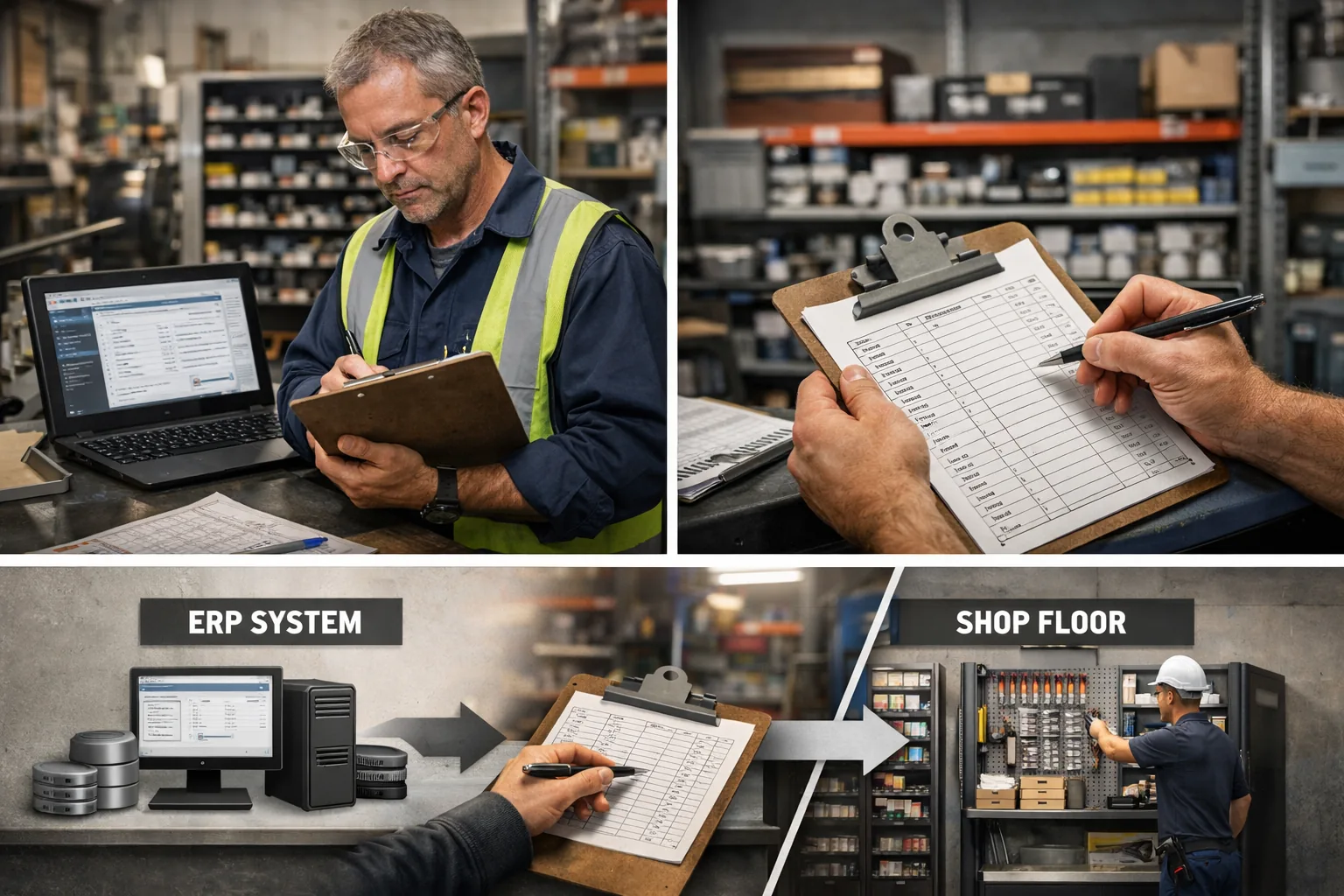
In many plants, inventory labor falls into four repetitive activities:
Physical counts and recounts
Cycle counts, spot checks, and end of month counts are often triggered because no one fully trusts the numbers.
Manual transaction entry
Parts are issued at the point of use, then logged later on paper, in spreadsheets, or retroactively inside the ERP.
Reconciliation and cleanup
Someone eventually compares physical stock, spreadsheets, and ERP quantities. This work doesn't improve production, it only attempts to prevent failures.
Exception handling
Emergency purchases, stockouts, misplaced items, and rush requests create interrupt-driven labor, which is the most expensive kind.
Why ERPs Don't Eliminate This Work
Systems like Prophet 21 are excellent at financial and transactional control. They are not designed to manage real time, point-of-use consumption on a plant floor. Consumption happens far from terminals. Transactions depend on memory and "I'll enter it later" becomes normal behavior. The ERP becomes a system of record, not a system of control, and labor is forced to fill the gap.
The Hidden Headcount Effect
Consider a conservative hypothetical example:
- Two inventory staff spending 1.5 hours per day counting and reconciling
- Four supervisors spending 30 minutes per day resolving inventory issues
- Six technicians losing 10 minutes per day searching for parts
That's 10–12 labor hours per day tied directly to inventory friction. The equivalent of 1–1.5 full-time employees over a year. Because the work is fragmented across roles, it often goes unnoticed or unaccounted for.
Why "Just Be More Disciplined" Fails
More procedures, training, or audits don't solve the problem. When inventory accuracy depends on memory, timing, and human follow through, labor cost is guaranteed. This is a system problem, not a discipline problem.
What Changes With Point-of-Use Automation
When inventory is captured automatically at the moment of use:
- Parts are issued as they're taken
- Transactions flow directly into the system
- Counts become continuous instead of episodic
- Exceptions shrink dramatically
Industrial vending and automated dispensing remove the manual layer between physical reality and the ERP. Learn more about point of use inventory automation and how it connects to your existing systems.
Why This Matters Now
Labor is harder to hire. Supervisory time is more valuable. Plants are expected to scale without adding headcount.
Manual inventory tracking worked when volumes were lower and labor was cheaper. Those conditions no longer exist.
Inventory problems are rarely about accuracy alone. More often, they're about how much human effort is required just to keep systems aligned with reality. Reducing that effort is where real operational leverage comes from.